

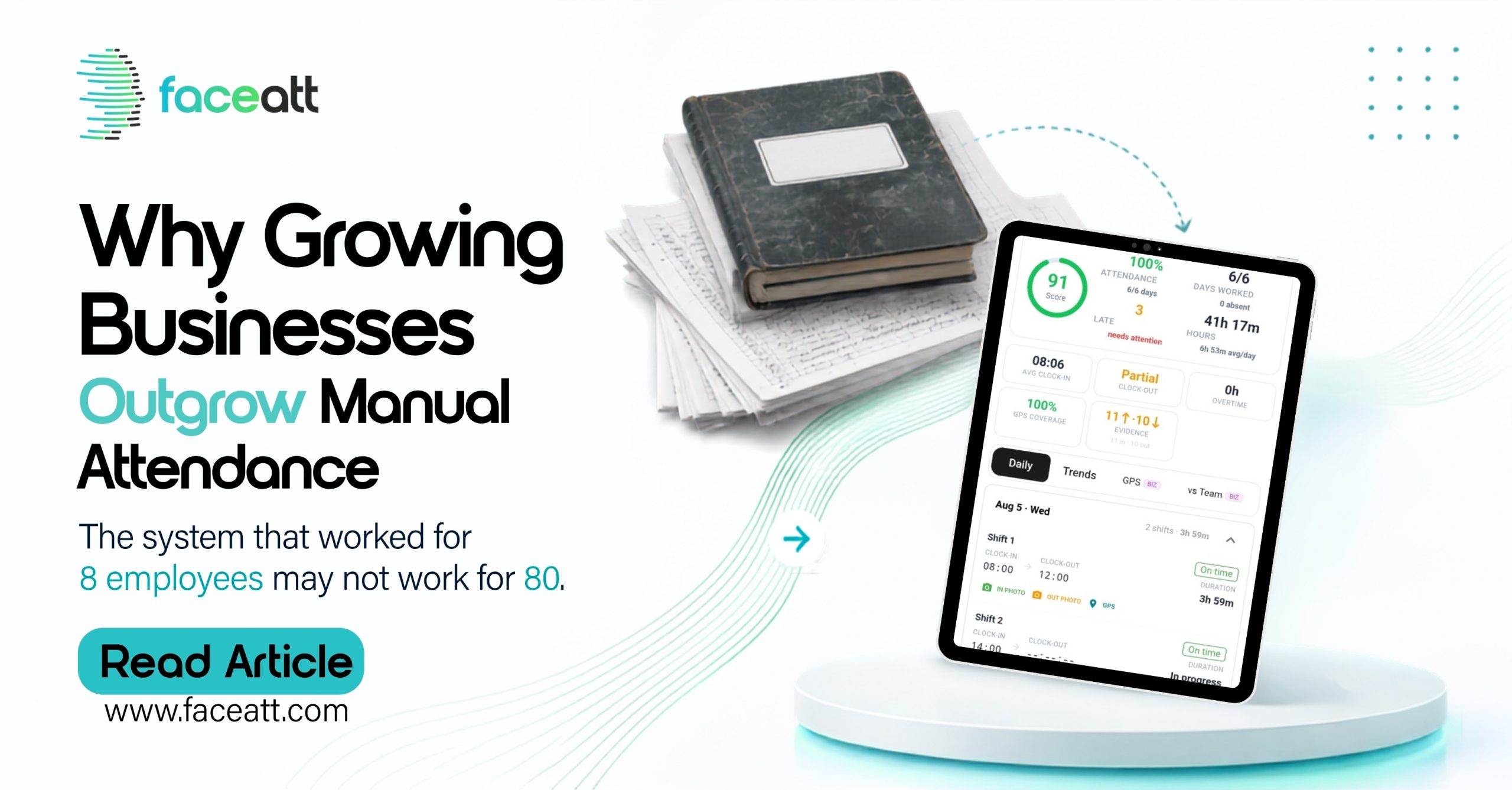
Why Growing Businesses Outgrow Manual Attendance
The system that worked for 8 employees may not work for 80.
At eight people, a sign-in sheet or a WhatsApp check-in group is manageable. Everyone knows everyone. If someone forgets to sign in, you notice, you ask, it gets sorted. But growth changes the math. More people, more shifts, more sites, and the informal system that used to hold everything together quietly starts to fail. Usually before anyone officially decides it has.
What breaks first as headcount grows?
Three things go first, and they don’t go in order.
Accuracy is usually the first crack. A colleague signs in for someone running late. A time is rounded up “because it’s basically the same.” A page of the register goes missing. None of it is malicious most of the time, but it adds up, and by the time you’re at 50 or 80 employees, small inaccuracies become real gaps between what was recorded and what actually happened.
Time goes next. Someone, usually in HR or ops, ends up spending hours each week chasing paper registers, retyping them into a spreadsheet, and cross-checking against payroll. That’s hours that scale with headcount, not with the value of the work.
Visibility is the one that catches growing businesses off guard. When you have one site, you can walk the floor and see who’s in. Once you have two or three sites, or a mix of office and field staff, that’s no longer possible. You’re relying on whoever is physically present to report accurately, and that reporting only gets less reliable as the business gets bigger.
The pattern is consistent: the system doesn’t fail dramatically. It just gets slower, fuzzier, and more expensive to run, one employee at a time.
Multi-site and field teams need more than a sign-in sheet
A sign-in sheet assumes one thing that stops being true as you grow: that everyone clocking in is standing in the same room as the sheet. Once you have a second branch, a warehouse, a construction site, or staff who move between client locations, that assumption breaks completely.
This is where location matters. On faceATT’s Business tier, GPS data is captured alongside each clocking event and shown in the attendance registry next to the clocking image. That means you’re not just confirming who clocked in, you’re confirming where they were when they did it. For a business managing multiple sites or a field team that doesn’t report to a fixed location every day, that’s the difference between a rough estimate of attendance and an actual, auditable record.
It also removes a very specific kind of guesswork for managers who can’t physically be at every location at once. Instead of following up after the fact, they can see attendance across every site from one place, as it happens.
Payroll complexity scales faster than headcount
Here’s the part that catches a lot of growing businesses off guard: payroll problems don’t grow at the same rate as your team. They grow faster.
At a small scale, an inaccurate clock-in or a late submission is a five-minute conversation. At a larger scale, the same category of error multiplies across more people, more shifts, and more approval steps, and it starts showing up as disputed hours, late payroll runs, and time spent reconciling records that should have matched in the first place. Unplanned absenteeism alone is estimated to cost businesses a meaningful share of payroll, and disputes over hours worked only add to that.
The businesses that feel this the least are the ones that moved to a system where the record of hours worked isn’t something someone has to reconstruct after the fact. It’s already there, timestamped, with evidence attached, ready to go straight into payroll.
What to look for when moving off manual attendance
If you’re at the point where the manual system is starting to cost more than it saves, here’s what actually matters when evaluating a replacement:
Verification you can trust. Attendance data is only useful if it reflects what really happened. Look for systems that confirm the person clocking in is actually the person on record, not just a code or a card that can be handed to someone else. faceATT uses face recognition with liveliness detection to prevent buddy punching, and stores the underlying face data as a non-reversible mathematical template rather than a photo, so verification doesn’t come at the cost of storing sensitive images unnecessarily.
Reporting that doesn’t need to be rebuilt every week. A good system gives you a clear, ready-to-use record: who was where, when, for how long. On faceATT’s Growth tier and above, a clocking image is captured at each event so both the employee and employer have visual confirmation of the record, not just a timestamp to take on faith.
Compliance built in, not bolted on. Biometric data carries a higher standard of care under South African data protection law. That means encryption, controlled access, and clarity about who is responsible for what. faceATT is hosted on secure infrastructure within South Africa, with data encrypted both in transit and at rest, and the employer stays in control of their own employees’ data throughout.
Growth is meant to be a good problem. Your attendance system shouldn’t be the thing that makes it feel like a bad one.
Ready to see what your attendance data could look like with proper verification, multi-site visibility, and reporting built in? Try faceatt.com