
5 Questions to Ask Before Switching Attendance Software
Switching attendance software is not a small decision.
You’re changing established processes, relying on new systems for payroll data, and asking your team to adapt to a different way of clocking in and out.
Before you make the switch, ask these five questions.
1. Does it actually save time, or just move the paperwork?
Many attendance systems promise to reduce admin, only to replace it with manual approvals, spreadsheet exports, and reports someone still has to compile.
The real test is what happens after an employee clocks in.
Can managers see who is present in real time? Can employees check their own attendance history without contacting HR? Can you access the information you need without building another spreadsheet?
If someone still has to manually gather and organise the data, the software hasn’t really removed the work. It has simply moved it somewhere else.
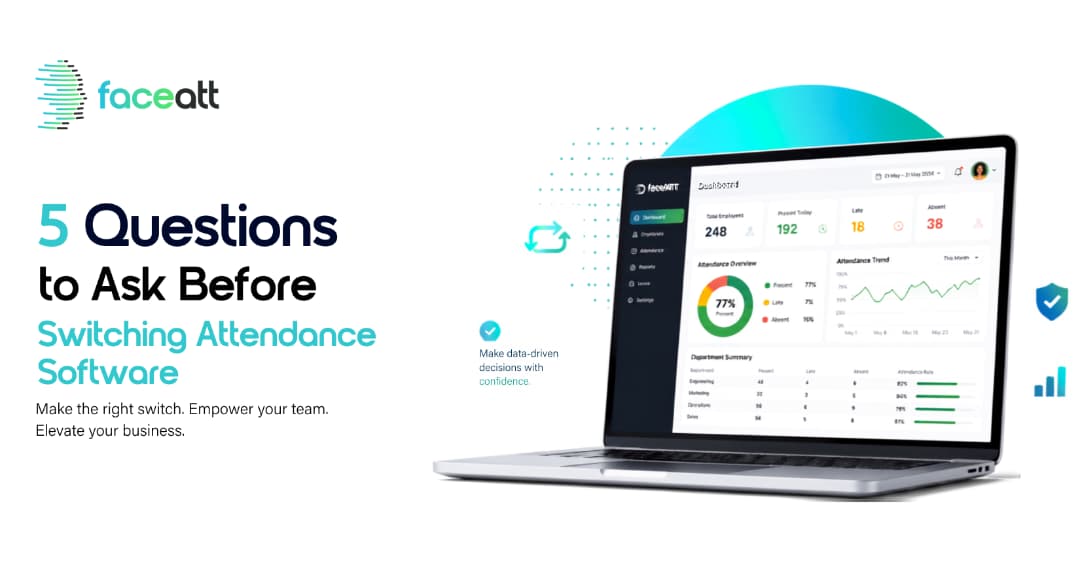
With faceATT, employees can view their own clock-in and clock-out history, while managers get a live attendance overview without having to request or compile reports.
That’s the difference between digitising a process and actually simplifying it.
2. Can it handle more than one site?
An attendance system might work perfectly for a single office. Add another branch, warehouse, construction site, or field-based team, and things can become more complicated.
Ask whether the system can verify where an employee clocked in, not simply record that they pressed a button.
This is where GPS and geo-fencing become important.
faceATT links clocking events to a location, helping businesses verify that employees are clocking in from the expected place.
For businesses operating across multiple locations, this can make attendance records more reliable and easier to manage.
3. How does it handle biometric data?
If you’re considering facial recognition, one of the most important questions is what happens to the biometric data being collected.
Under South Africa’s Protection of Personal Information Act (POPIA), biometric information is classified as special personal information and requires appropriate protection.
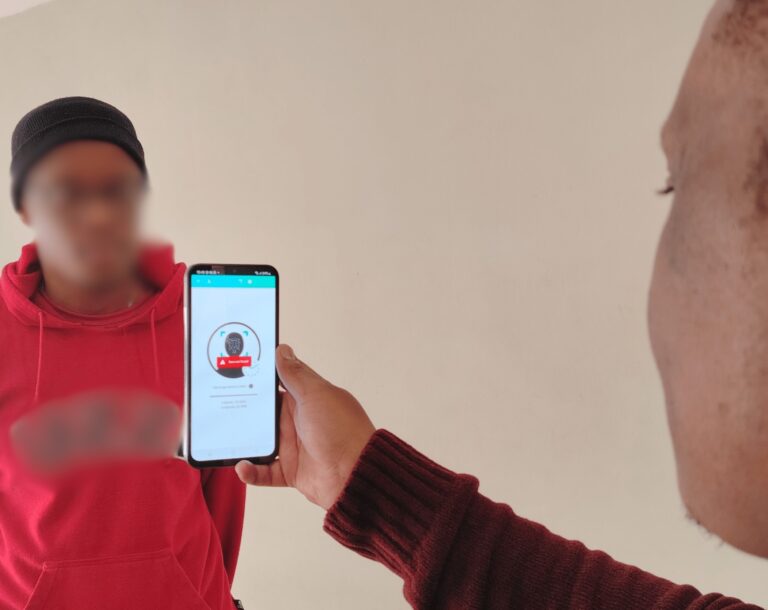
With faceATT, the facial data used to recognise an enrolled employee is stored as a mathematical template rather than a photograph. The template cannot be reverse-engineered into an image of the individual.
Clocking images, where enabled, are a separate feature available from the Growth tier upwards. These images are visible to both the employee associated with the record and the employer, providing transparency around the attendance record.
It’s also important to understand the responsibilities involved. The employer remains the responsible party for handling consent and its obligations to employees, while faceATT processes the data on the employer’s instructions.
If POPIA compliance matters to your business, these are questions worth asking before choosing any biometric attendance system.
4. What happens when there’s no internet?
Load shedding and unreliable connectivity aren’t theoretical challenges for South African businesses.
If your attendance system requires a constant internet connection, an outage could quickly become an attendance and payroll problem.
Ask what happens when the connection drops.
Can employees still clock in? Is their attendance recorded? Does the system automatically sync the data once connectivity returns?
faceATT includes offline mode with automatic syncing, allowing employees to clock in and out without an active internet connection. Once connectivity is restored, the records sync automatically.
It’s a feature you may not think about until you need it.
5. What is the real cost?
The price displayed on a homepage rarely tells the whole story.
Some platforms charge separately for additional users, locations, reports, or features that you may expect to be included.
Before switching, ask providers to clearly explain what you get at each pricing tier and what costs extra.
faceATT offers a free tier for teams of up to 10 users, with paid plans starting from R47 per user per month.
When comparing providers, look beyond the starting price and compare what you’ll actually receive for what you’ll actually pay.
Making the Switch
There isn’t one attendance system that works for every business.
What matters is whether the system you choose can genuinely reduce admin, support your operational needs, protect employee data, work when connectivity fails, and provide clear, predictable pricing.
Before you switch, ask the questions that matter.
Want to see how faceATT can simplify attendance management for your business?
Visit faceATT to learn more.
This article is for general information only and does not constitute legal advice. For POPIA compliance specific to your business, consult a POPIA-experienced advisor.